
Three new glowing sharks light up twilight zone
Three new species of bioluminescent sharks — including the largest known underwater glowing creature — have been found in deep, dark water off the coast of New Zealand


READING LEVEL: GREEN
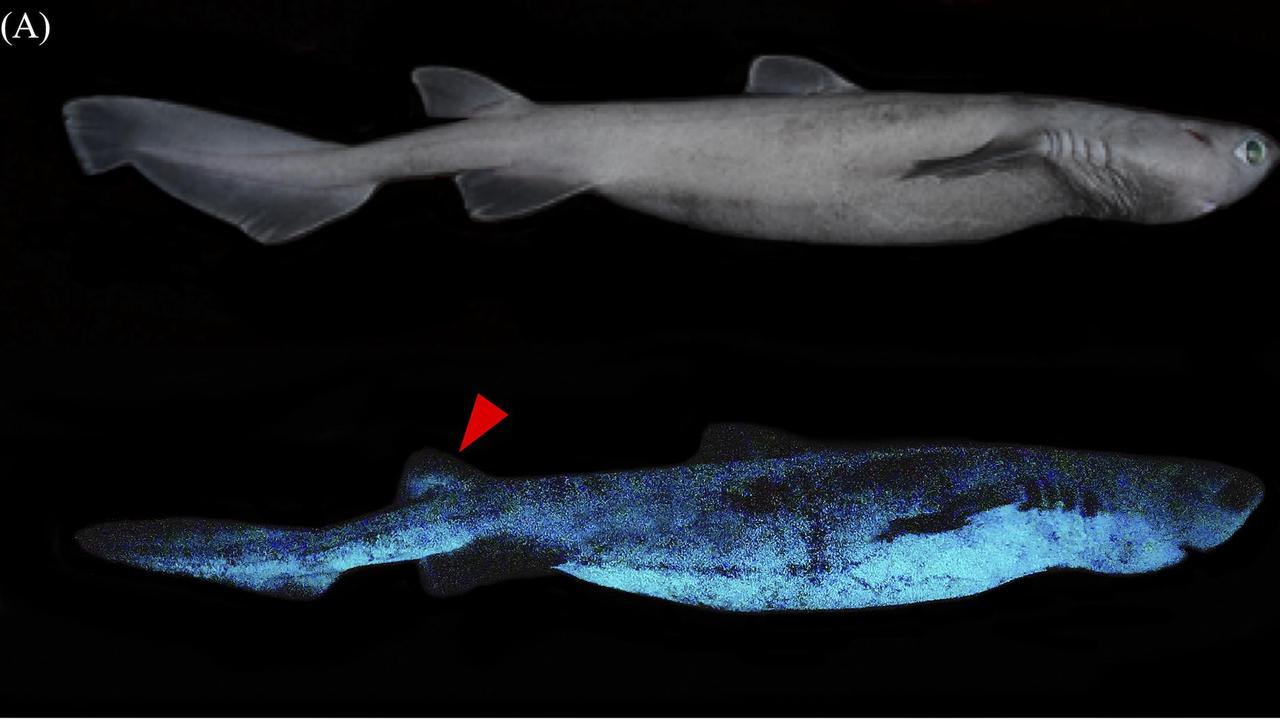
Three new species of sharks have been found off the coast of New Zealand and they all glow in the dark.
The amazing creatures were discovered by researchers hundreds of metres below the surface of an ocean area called the Chatham rise in the South Pacific Ocean off the New Zealand east coast.
The sharks are called the kitefin shark, the blackbelly lanternshark and the southern lanternshark.
Their scientific names are Dalatias licha, Etmopterus lucifer and Etmopterus granulosus.
Scientists actually found them back in January 2020 but they’ve just published a study that focuses on the kitefin shark, the largest known underwater creature that glows in the dark.

Kitefin sharks swim 300m below sea level, which is probably why it’s taken so long to discover them.
They eat other sharks, fish and crustaceans.
Kitefins can grow to almost 1.8m, which is around the average height of a human man.
Researchers now refer to it as a “giant luminous shark” but it’s nowhere near as big as a great white shark, which can grow to more than 6m.

The study was conducted by marine biologists from Belgium and New Zealand and has been published in the Frontiers in Marine Science journal.
The researchers wrote: “Bioluminescence has often been seen as a spectacular yet uncommon event at sea but considering the vastness* of the deep sea and the occurrence of luminous organisms in this zone, it is now more and more obvious that producing light at depth must play an important role structuring the biggest ecosystem on our planet.”
All three sharks were found in a region of the sea called the “twilight zone”.
This is an area between around 200m and 1000m below the surface that sunlight does not reach.
It’s thought the sharks use their glow to attract or hide from prey at these depths and may even use it to confuse potential predators.
However, the kitefins are so large they don’t have many predators.
Researchers will continue to study them to find out exactly why they glow.
They wrote: “Studying light emission* of the kitefin shark, the blackbelly lanternshark, and the southern lanternshark, might increase our understanding of their bioluminescence functions, and possible prey-predation relationships between these species.”

SOME OTHER GLOWING CREATURES
- Glow worms, a general name people use to refer to the larvae and adult life-cycle stages of a variety of insects such as beetles and mosquito-like gnats
- Firefly squid
- Crystal jellyfish
- Quantula striata, a tropical land snail
This story was first published on The Sun and is republished with permission.

GLOSSARY
- vastness: large size of something
- emission: putting out something, such as light or sound
EXTRA READING
Dolphins dance through glowing algal bloom
Giant squid attacks fake jellyfish near midnight zone
Inside the shark tank Sea Life Aquarium
QUICK QUIZ
- What has been discovered? Where?
- In what depth of water do they live?
- Why might they glow? Do we know?
- What are glow worms?
- What is Quantula striata?
LISTEN TO THIS STORY
CLASSROOM ACTIVITIES
1. What Do You Think?
List the advantages of being able to glow in the dark for the kitefins and laternsharks. Are there any disadvantages? List those too.
Time: allow 20 minutes to complete this activity
Curriculum Links: English, Science, Critical and Creative Thinking
2. Extension
If we could tame the glowing sharks, how do you think they could help us? Brainstorm as many ideas as you can.
Time: allow 20 minutes to complete this activity
Curriculum Links: English, Science, Critical and Creative Thinking
VCOP ACTIVITY
Aside from this, there is also this!
Brackets are a great literacy tool for adding aside comments, or comments that could be covered over and the sentence still makes sense. What’s inside the brackets is extra information.
They can be used for a variety of effects: to add more detail, to add humour, to connect with the reader etc.
For example: My little brother, (the funniest kid I know) got himself into big trouble today.
Select 3 sentences from the article to add an aside comment to using brackets. Think about not only what you want to add to the sentence, but also what effect you are trying to create.