
Why young manta rays stay close to home until they’re fully grown
Magnificent manta rays can migrate hundreds of kilometres, yet juvenile mantas must reach an important milestone before venturing out into the open ocean as new research reveals why


READING LEVEL: GREEN
While adult manta rays roam freely, young manta rays stay much closer to home until they have “grown up”, new research shows.
Anyone who has watched a manta ray glide over a reef knows how relaxed these marine animals can look. Yet researchers working off Costa Rica found their movements are varied, with young mantas staying nearby and close to shore while adults venture hundreds of kilometres.
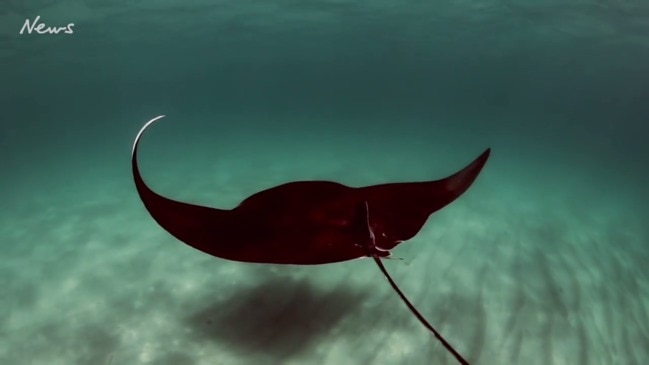
Manta rays are among the ocean’s largest fish, with winglike fins that can span up to about 8m, and the largest brain of any fish.
Researchers tracked endangered oceanic manta rays between 2018 and 2025, fitting 59 of them with acoustic transmitters* and tracking 12 with satellite tags, along with photo identification.

“By combining different technologies … we were able to piece together a highly detailed map of their movements and their use of coastal cleaning stations,” said Jeffry Madrigal-Mesén, director of the research group Mantas Costa Rica and lead author of the study published in the journal Frontiers in Fish Science.
A coastal cleaning station is a rocky reef site where small fish remove parasites* from the skin of the manta rays in an example of symbiotic* behaviour.

Researchers found that smaller, younger mantas stayed within Costa Rica’s coastal waters, called its exclusive economic* zone. Larger, mature animals undertook long-distance journeys, some reaching as far as the waters off Guatemala.
“This makes us believe that smaller mantas do not risk these long migrations, likely due to the threat of large predators like orcas and tiger sharks,” Mr Madrigal-Mesén said.
The smaller animals in the study measured around 3m to 3.5m across, compared to around 4m to 4.5m for those making the longer journeys.

DANGER FROM PREDATORS
A juvenile, at around 3m across, would still appear enormous to most swimmers. Yet that size may not be enough protection.
“Their massive size is one of their main defence mechanisms,” Mr Madrigal-Mesén said. “It is quite common to see animals missing portions of their bodies, and in many cases, the shape
of the wounds strongly suggests they are bites from other large marine predators.”
What prompts mantas to eventually join the migratory* population remains unclear, although researchers suspect that reaching feeding and breeding grounds in highly productive waters across Central America may play a role.

The manta rays also repeatedly return to the same coastal cleaning stations. Observations of feeding, courtship and recent mating suggest these sites may also function as social hubs.
Scientists do not yet know how mantas navigate back to particular sites.
“Based on the bathymetry* of the different sites we monitor, there must be a relationship with the rock formations. We humans have favourite places we like to go to,” Mr Madrigal-Mesén said.
“Why couldn’t mantas have a preference for one cleaning station over another?”
The findings also suggest the mantas may not roam as far as once thought.
Researchers initially suspected that animals seen in Costa Rica might migrate from populations in Ecuador or Mexico. The tracking data instead raises the possibility that Central America has its own distinct population, something the team is now investigating through genetic* work.

Mantas are particularly vulnerable because, like other rays and sharks, they reproduce slowly and take years to reach sexual maturity*. Mr Madrigal-Mesén said that once the animals left Cocos Island, a volcanic island in the Pacific Ocean, and most monitored coastal sites, they entered waters with no protection, exposing them to threats including fishing and vessel traffic.
“Studies like this help us recognise that these coastal havens only protect them for a specific time of the year,” he said. “This is why it is so critical to protect the marine corridors these migratory species travel through.”

Coastal mantas also showed strong site loyalty, with very few moving between monitoring sites even when they were only tens of kilometres apart.
One male became a particularly striking example. Nicknamed “mickey mouse” for its distinctive spot pattern, the ray was repeatedly photographed at Cabo Blanco and tracked using both satellite and acoustic tags, showing a strong attachment to the site.
But researchers have not seen this ray in Costa Rica for more than a year.
“We have a lot of affection for him,” Mr Madrigal-Mesén added. “We hope he comes back soon.”
Minor edits have been made to this story for Kids News. Reuters reporting by Marta Serafinko in Gdansk; Editing by Will Dunham
WATCH THE VIDEO
POLL
GLOSSARY
- acoustic transmitters: monitoring and tracking devices that emit sound pulses
- parasites: organisms that live in or on another organism’s body, getting its nutrients, food and energy
- symbiotic: a long-term biological relationship between two different species
- exclusive economic: an Exclusive Economic Zone is a geographical boundary of up to 200 nautical miles (about 370km) from a country’s baseline
- migratory: relating to the long distance travel from one area to another that certain animals undertake
- bathymetry: the science of mapping underwater floors in oceans, rivers and lakes and measuring water depth
- genetic: studying DNA traits that indicate certain physical characteristics
- sexual maturity: the developmental age at which manta rays are able to start reproducing
EXTRA READING
Eagle ray brothers born in captivity
‘Pink Panther’ manta ray spotted off Qld
Hurt manta ray begs Aussie snorkeller for help
QUICK QUIZ
1. Why do younger manta rays stay closer to home?
2. What size do mature manta rays grow to?
3. What techniques were used to study the manta rays in the research mentioned?
4. What is one reason that mantas are particularly vulnerable as a species?
5. What are coastal cleaning stations?
LISTEN TO THIS STORY
CLASSROOM ACTIVITIES
1. News: condensed
Identify the most important pieces of information in this article and write a condensed version of it using 50 words or less.
Draw a picture or diagram to support your condensed news story.
Time: allow 25 minutes to complete this activity
Curriculum Links: English, Science
2. Extension
Compare your condensed news story with a classmate. Did you both include the same information or are your stories quite different? Discuss your choices and then work together to create a final condensed version of the story that you both agree tells the important parts that a reader would need or want to know.
Time: allow 20 minutes to complete this activity
Curriculum Links: English
VCOP ACTIVITY
Read this!
A headline on an article – or a title on your text – should capture the attention of the audience, telling them to read this now. So choosing the perfect words for a headline or title is very important.
Create three new headlines for the events that took place in this article. Remember, what you write and how you write it will set the pace for the whole text, so make sure it matches.
Read out your headlines to a partner and discuss what the article will be about based on the headline you created. Discuss the tone and mood you set in just your few, short words. Does it do the article justice? Will it capture the audience’s attention the way you hoped? Would you want to read more?
Consider how a headline or title is similar to using short, sharp sentences throughout your text. They can be just as important as complex ones. Go through the last text you wrote and highlight any short, sharp sentences that capture the audience.