
Great Barrier relief as coral coverage returns
Coral coverage on the northern and central parts of the Great Barrier Reef is at its highest level since monitoring began 36 years ago, a new report shows


READING LEVEL: GREEN
Coral coverage on the northern and central parts of the Great Barrier Reef is at its highest level since monitoring began 36 years ago, the latest monitoring report has found.
The annual report from the Australian Institute of Marine Science (AIMS), released on August 4, reveals reef coral coverage in the north has grown from 27 per cent last year to 36 per cent in 2022, while in the central region it has increased from 26 to 33 per cent.
Both represent record levels.
In the southern region, coral coverage dropped from 38 per cent in 2021 to 34 per cent this year.
Assessing all 2900 reefs that make up the 2300km-long natural wonder would be impractical*.
AIMS’ findings come from in-water monitoring of 87 reefs, the vast majority of which have been studied in previous years. A few are sites of reef restoration projects.


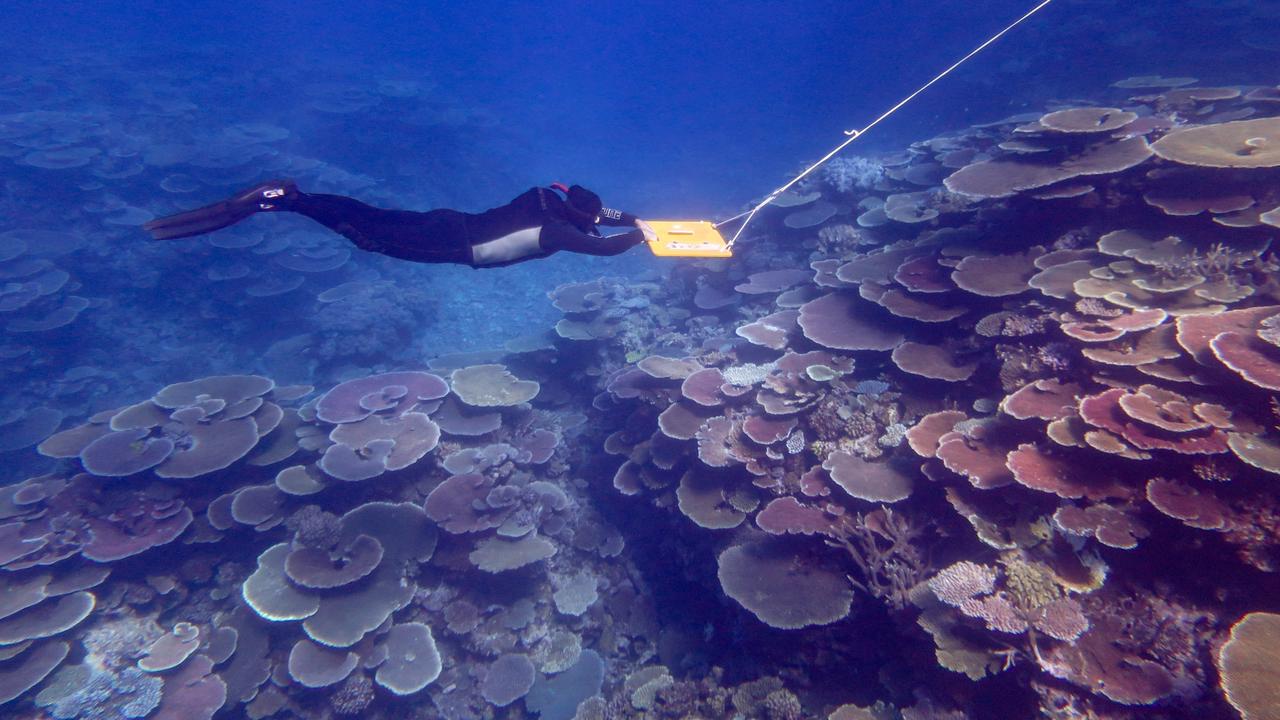
Researchers are towed behind boats and assess the coverage and condition of the coral visually.
Just before the federal election, the Great Barrier Reef Marine Park Authority quietly released findings of an aerial survey of 719 reefs, finding evidence of bleaching* on 91 per cent of them.
AIMS also found evidence of bleaching, although some of its most recent surveys were conducted before last summer’s bleaching event, the fourth in seven years.
Head researcher Dr Mike Emslie said the 2016 and 2017 bleaching events led to widespread coral mortality*, but the marine heatwaves that prompted bleaching in 2020 and 2022 were shorter in duration and less intense.
“There will probably be some corals that have died from this event, but we’re not going to see anywhere near the levels like we saw in 2016, 2017,” Dr Emslie said.
“All bleaching events are different and the fact we’ve had four now in seven years and one in a La Nina year is really concerning. The reef is in uncharted territory*.”

The recovery of reefs in the north and central regions was driven by several factors, including fewer destructive storm events, and the regrowth was being spearheaded* by fast-growing Acropora corals, Dr Emslie said.
But while these corals can replenish* quickly, they are also more susceptible* to storm damage and bleaching than other coral formations, he said.
The Acropora corals are also the preferred food of the crown of thorns starfish, which remains a scourge*, particularly in the waters stretching between Proserpine and Gladstone.
The AIMS study found signs of crown of thorns outbreaks on seven of the 28 reefs they surveyed in this region.
AIMS chief executive Dr Paul Hardisty said a third of coral growth detected in the south last year had been subsequently* wiped out by crown of thorns starfish outbreaks.
“This shows how vulnerable* the reef is to the continued acute* and severe* disturbances that are occurring more often, and are longer-lasting,” he said.

A crown of thorns control program, currently funded by the Great Barrier Reef Foundation, has culled* 1.1 million of the creatures over the past decade.
Foundation program director Dr Mary Bonin said the crown of thorns starfish was native* to reefs throughout the Pacific, so the goal was not to eradicate* them, but to manage their numbers in regions where coral was struggling to survive.
“It’s not about getting rid of all the starfish … it’s about getting them down to that level where coral growth and recovery outpaces the impact of their feeding,” Dr Bonin said.
GLOSSARY
- impractical: not sensible or realistic to do
- bleaching: when coral turns white because it is stressed by warming water and forces out the algae living in its tissues
- mortality: death
- uncharted territory: refers to a situation or place not experienced before
- spearheaded: led
- replenish: restore, return to an earlier condition
- susceptible: likely to be hurt by something
- scourge: something that causes great trouble or suffering
- subsequently: afterwards, happening at a later time
- vulnerable: at risk of being harmed
- acute: very serious, extreme or severe
- severe: very great, serious, dangerous
- culled: killed to control the size of a group
- native: originally grew and lived in a particular place
- eradicate: destroy completely
EXTRA READING
Great Barrier Reef’s summer of bleach grief
Google AI to help rescue Great Barrier Reef
Reef avoids ‘in danger’ listing for now
Evidence of regrowth on the Great Barrier Reef
QUICK QUIZ
- Which institute conducted the annual monitoring report?
- How much has coral reef coverage grown in the northern parts of the Great Barrier Reef?
- How much has coral reef coverage grown in the central region?
- How many reefs were monitored?
- What is the name of the type of coral spearheading the regrowth?
LISTEN TO THIS STORY
CLASSROOM ACTIVITIES
1. Make it visual
Create a graph, chart or table to compare AIMS’ data from last year to this year. Think about which type of graph, chart or table will best visually represent the data, and use scale and colour in a way that makes it easy for viewers to quickly understand.
Time: allow 30 minutes to complete this activity
Curriculum Links: English; Mathematics
2. Extension
Overall, do you think this news article indicates a negative or positive long-term outlook for the Great Barrier Reef? Provide evidence from the story to justify your reasoning.
Time: allow 20 minutes to complete this activity
Curriculum Links: English
VCOP ACTIVITY
Wow word recycle
There are plenty of wow words (ambitious pieces of vocabulary) being used in the article. Some are in the glossary, but there might be extra ones from the article that you think are exceptional as well.
Identify all the words in the article that you think are not common words, and particularly good choices for the writer to have chosen.
Select three words you have highlighted to recycle into your own sentences.
If any of the words you identified are not in the glossary, write up your own glossary for them.