
Queen now peacefully laid to rest with her husband Prince Philip
After 10 days of national mourning, including many historic scenes of extraordinary grief and grandeur, Queen Elizabeth II has been laid to rest at St George’s Chapel in Windsor Castle


READING LEVEL: GREEN
King Charles III held back tears as Queen Elizabeth II was reunited with her beloved husband, Prince Philip, at St George’s Chapel in Windsor Castle.
The King, Prince William and Prince Harry were among those forming a guard of honour as the Queen arrived for a final service at St George’s Chapel in Windsor after the hearse* had passed through the streets of London following the Westminster Abbey funeral service.

Cannons fired, the bell tolled and bagpipes played “Flowers of the Forest” as the Queen’s hearse passed through the Norman Gates. The Scottish folk song remembers the Scottish army defeated at the Battle of Flodden in 1513, and is the traditional tune played after the funeral of the sovereign*.
Her Majesty was carried into the church with the sound of a beautiful choir.

Prince William waited for his brother Prince Harry before he took up his seat in the chapel.
The brothers were seated in front of the Queen’s coffin, along with Princess Catherine.
Prince George, 9, and Princess Charlotte, 7, sat alongside their parents and uncle.
His Majesty the King stood silently as his mother’s coffin was lowered into the Royal Vault, seen for the last time as 10 days of national mourning ended with extraordinary scenes of grief and grandeur*.
The Queen was laid to rest alongside her husband and her parents – King George VI and the Queen Mother.

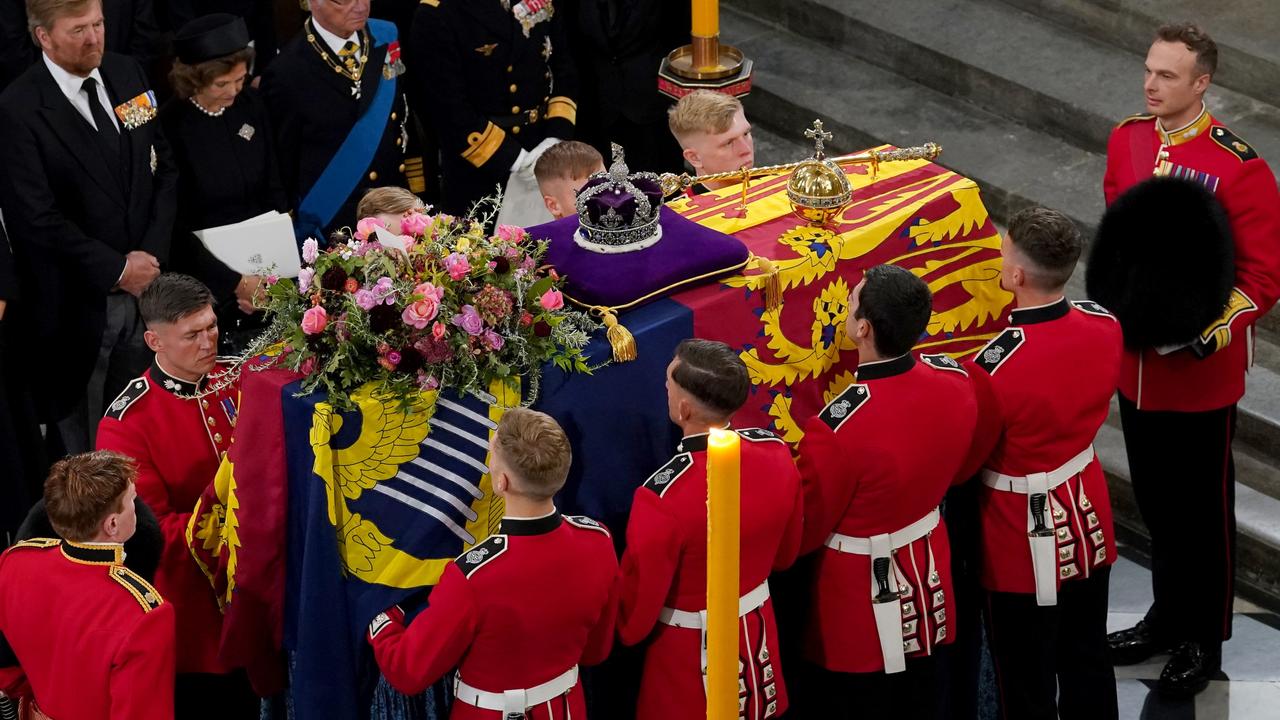
The symbols of the Queen’s sovereignty, her Crown and sceptre*, were removed from her coffin to prepare for her interment*.
The glittering crown, which has 3000 diamonds, had been on her coffin since it was placed in Westminster Hall five days ago.

World leaders and global royalty had earlier joined 2000 mourners for the funeral service at the 1269-year-old Westminster Abbey, while the public flooded the city and billions more tuned in around the world.
During the service, the Duke of Sussex shared a reassuring smile with Charlotte, who was joined by the Queen’s other great-grandchildren, Isla and Savannah Phillips, 11 and 10 and Mia Tindall, 8.

The Kings’ Coldstream Guards led a spectacularly colourful display of the armed forces marching in columns ahead of the royal procession to the Wellington Arch.
Hundreds of thousands lined the streets to see the Royal Hearse on the last leg of its journey, which had started in Scotland, and follow the “Long Walk” home to the Queen’s final resting place.

The Queen’s coffin was also taken around the fountain in front Buckingham Palace, where so many of her favourite memories were made, including her Platinum Jubilee – celebrating 70 years on the throne – and where she slipped out in military uniform joining the crowds when Britain declared victory in World War II in 1945.
The Queen’s household staff formed a guard of honour outside Buckingham Palace.
Her beloved corgis, Muick and Sandy, waited patiently at Windsor for the Queen’s coffin to arrive for the Committal Service at St George’s Chapel. The corgis will now live with Prince Andrew. The Queen’s horse Emma farewelled her owner with a single stamp of a hoof.

The Dean of Windsor, Rev David Conner, remembered the Queen as someone “whose uncomplicated yet profound*” faith bore fruit in her life of “service to the nation, the Commonwealth and the wider world”.
He praised her “calm and dignified presence” in a “rapidly changing and frequently troubled world”.
“(She) has given us confidence to face the future, as she did, with courage and with hope,” he said.

A handwritten note on top of the Queen’s coffin was said to be from King Charles and signed “In loving and devoted memory, Charles R.”
Across the world, people joined in a minute of silence at 8.59pm London time.
The wreath on Her Majesty’s coffin was a collection of flower cuttings from significant places in her life – Buckingham Palace, Clarence House and Highgrove House. Chosen by the King, the wreath also included rosemary for remembrance and myrtle cut from the plant grown from Queen Elizabeth’s bridal bouquet.

The Archbishop of Canterbury, Justin Welby, who knew the Queen personally, delivered the Westminster sermon for Queen Elizabeth.
New British Prime Minister Liz Truss delivered a poignant* reading at the Queen’s funeral.
A contingent of nine exceptional Australian citizens, led by Australian of the Year Dylan Alcott, attended the Queen’s funeral at Westminster Abbey.

Australia’s Prime Minister Anthony Albanese was seated seven rows behind King Charles for the service. He arrived alongside his Canadian counterpart, Prime Minister Justin Trudeau.
The Australian guests were seated in the Nave, with the royal family in the Lantern.
Speaking from London just before the funeral, Mr Albanese told 2GB viewing Her Majesty’s body lying in state was “just quite extraordinary”.
“There is certainly a deep affection for Queen Elizabeth. You can just feel it right around the streets of London,” Mr Albanese said.
GLOSSARY
hearse: a vehicle used to carry a coffin to a funeral
sovereign: the highest power, holding the position of ruler
grandeur: the quality of being very large, special or beautiful
sceptre: a decorated, ceremonial baton carried by a queen or king as emblem of authority
interment: the act of burying someone after their death
profound: very great or intense emotion or having great meaning
poignant: causing or feeling a strong sense of sadness
EXTRA READING
Parks plea: no Paddington toys for Queen
Queen’s final journey is underway
World mourns loss of Queen Elizabeth II
QUICK QUIZ
Where was the final service for the Queen held?
Where was the main service held and how many mourners attended?
Which favourite moments did the Queen celebrate at Buckingham Palace?
How many Australians attended the Westminster Abbey service and who were they led by?
The Queen’s corgis will now live with which of her children?
LISTEN TO THIS STORY
CLASSROOM ACTIVITIES
1. Funeral traditions
After watching some of Queen Elizabeth’s final farewell, and reading about it in the Kid News article, note some of the rich traditions you noticed the Royal Family partaking in.
–
–
–
–
–
Do you think the huge crowd and TV audience would comfort her family or make them feel uncomfortable in their grief? Explain your answer.
Time: allow 20 minutes to complete this activity
Curriculum Links: English; Personal and Social; Critical and Creative Thinking
2. Extension
What happens now to the Queen after her final farewell?
How do you think Queen Elizabeth II would like to be remembered?
Time: allow 10 minutes to complete this activity
Curriculum Links: English; Personal and Social; Critical and Creative Thinking
VCOP ACTIVITY
A letter to the Queen
Today we say goodbye to Her Majesty the Queen. She was such an iconic woman who was well-respected, gracious and hardworking. She will be dearly missed.
Write a letter to the Queen, her family, or an important female in your world. Share your thoughts and feelings towards them. Why did you choose to write the letter to them? How do they make you feel, and why?
If you can’t write a letter, design a poster or create a poem that pays your respects to the person you have chosen.
Use your VCOP skills to ensure your work reflects your voice and style, as well as connects with your chosen audience.