
Images reveal mega crater left by NASA’s asteroid-deflecting mission
Scientists have been given a front-row look at what happens when you try to deflect an asteroid, with an ESA probe revealing a mammoth crater at the sight of impact after the DART mission


READING LEVEL: GREEN
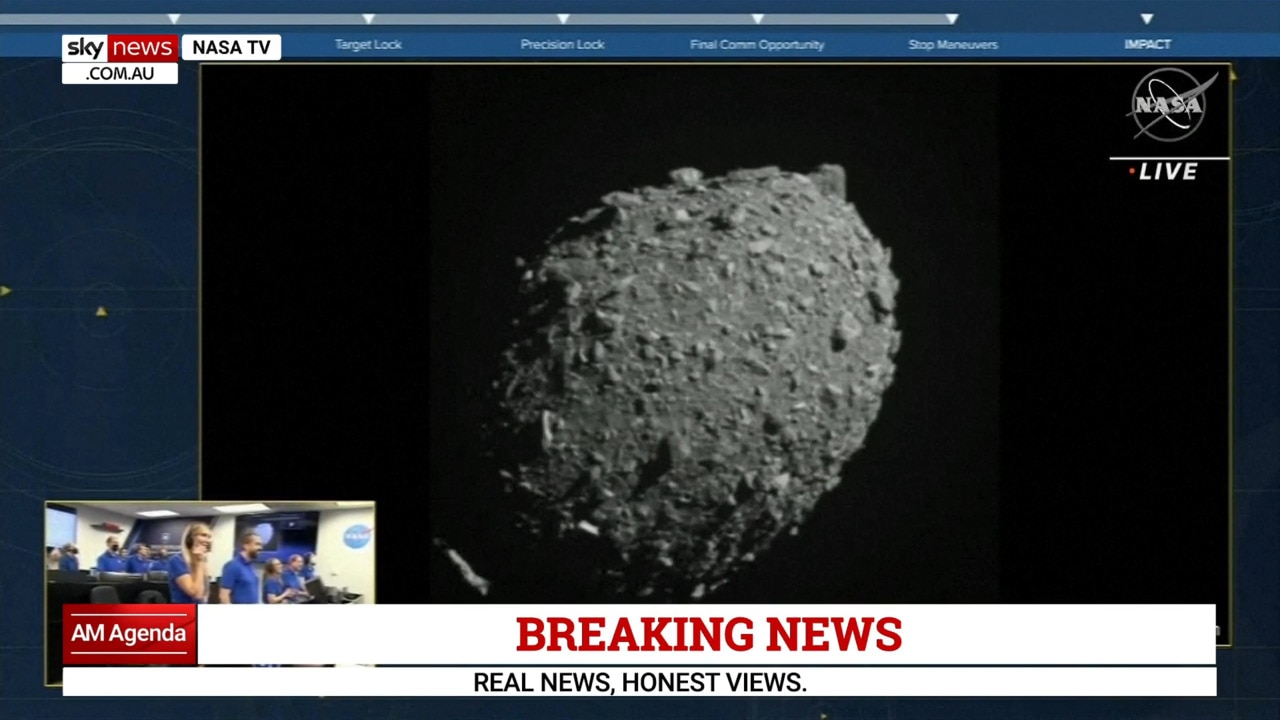
An asteroid deliberately struck by NASA has been left with a massive, stadium-sized crater, new images have revealed.
The battered rock has been tumbling chaotically through space ever since its 2022 midair encounter with mankind, with hundreds of boulders orbiting in the surrounding system.
For the past four years, researchers have been mostly in the dark about how humanity’s first full-scale asteroid-deflection* experiment went.

Now a European spacecraft has finally arrived to inspect the damage - and there was plenty to see, to say the least.
The European Space Agency released the images from its Hera probe on Wednesday, revealing what happened when NASA’s DART spacecraft slammed into the approximately 151m-wide Dimorphos in September 2022.
Experts have made clear that neither Dimorphos, nor its larger companion, Didymos, threatened Earth; they were chosen in part because they posed no danger to our planet.

The pair, which orbit each other, were selected as a testing ground for DART, which reportedly made contact with Dimorphos at an incredible 22,000km/hr.
The collision shortened Dimorphos’ roughly 12-hour orbit around Didymos by 33 minutes, comfortably exceeding NASA’s minimum target of 73 seconds.
But measuring a change in its orbit from Earth could only tell scientists so much. Hera’s arrival has supplied the close-up view, and the little asteroid has taken quite a beating.

“The side impacted is now completely covered by a crater, with the visual impression that a piece of the asteroid was cut off by the impact,” ESA’s Hera mission scientist Dr Michael Küppers said.
“We do not see evidence for major changes on the site opposite to the DART impact. The combination of those two observations is surprising.”
Dimorphos is thought to be a loosely packed collection of rubble, rather than one solid lump of rock. Understanding how that material responded to the collision is essential in order for scientists to apply the technique elsewhere.

The goal was never simply to prove that NASA could hit something very far away. That has been settled.
What scientists wanted to learn was how to use a collision to impact trajectory*, sort of like a cue ball in pool.
“We knew that the DART mission impacted Dimorphos successfully and that it changed its orbit,” Dr Küppers said. “But we did not know what happened to Dimorphos itself.”

Hera is currently observing from about 25–30km away. It is due to move within roughly 13km in December, before deploying two shoebox-sized satellites in January 2027 to investigate more closely.
One satellite will use radar to probe the asteroid’s interior. The other will examine its materials and surrounding dust.
The newly discovered orbiting boulders give the team something else to watch as the Hera spacecraft approaches.
WATCH THE VIDEO
POLL
GLOSSARY
- asteroid-deflection: the process of changing an asteroid’s speed or trajectory so that it misses Earth or whatever object is in its path
- trajectory: the path an object follows through space and time
EXTRA READING
NASA move for medium asteroids
Aussie team to assess asteroid risk
Webb telescope on asteroid’s tail
QUICK QUIZ
1. What year did the DART spacecraft smash into Dimorphos?
2. What was the purpose of this experiment?
3. What is the name of the larger asteroid that Dimorphos orbits around?
4. How did the impact affect Dimorphos?
5. What will Hera study as it moves closer to the impacted asteroid?
LISTEN TO THIS STORY
CLASSROOM ACTIVITIES
1. Make a model
Gather or make (depending on the time and materials available) objects to represent the two asteroids, the DART spacecraft and the Hera probe.
Work with a partner to use your objects to ‘act out’ the space mission. Show how DART collided with Dimorphos, what happened as a result of the impact, and how the Hera probe travelled to the asteroid to investigate the damage.
Time: allow 15 minutes + to complete this activity
Curriculum Links: English; Science
2. Extension
Use a device such as an iPad to record a ‘stop motion’ animation based on your work in the above activity.
Time: allow 45 minutes to complete this activity
Curriculum Links: English; Science; Media Arts
VCOP ACTIVITY
What happens next?
Imagine the full story turns out to be in three parts and this article is only Part One. Think about what the rest of the story could be and write the next two parts that tell the rest of this story.
Time: allow 30 minutes to complete this activity
Curriculum Links: English, Critical and Creative Thinking

Wild new hidden planet theory
Read more

Huge moon dubbed a ‘beaver’
Read more